Reinforcement Learning Without Temporal Difference: A Divide-and-Conquer Paradigm for Long-Horizon Tasks
Introduction
Reinforcement learning (RL) has achieved remarkable successes, from game-playing to robotic control. Yet, scaling RL to complex, long-horizon tasks remains a stubborn hurdle. The main culprit? Temporal difference (TD) learning—the core of many popular algorithms like Q-learning. While TD learning enables efficient updates, it suffers from error propagation that worsens over long sequences. In this article, we explore an alternative paradigm: divide and conquer. This approach sidesteps TD learning entirely, offering a fresh path toward scalable off-policy RL.
Understanding Off-Policy Reinforcement Learning
To appreciate the divide-and-conquer method, we must first grasp the off-policy RL setting. RL algorithms fall into two broad categories:
- On-policy RL: Only fresh data from the current policy can be used. Old data is discarded after each update. Examples include PPO and GRPO. These methods are simpler but inefficient when data collection is costly.
- Off-policy RL: Any data—past experiences, human demonstrations, or even internet logs—can be reused. This flexibility is crucial in domains like robotics, healthcare, or dialogue systems, where collecting new samples is expensive. However, off-policy algorithms are harder to stabilize and scale.
As of 2025, on-policy methods have solid recipes for scaling. Off-policy methods, despite their flexibility, lack a reliable, scalable solution for long-horizon tasks. Why? The challenge lies in how we learn values.
The Challenge of Temporal Difference Learning
In off-policy RL, we typically train a value function using TD learning, e.g., the Q-learning update:
Q(s, a) ← r + γ maxa' Q(s', a')
This bootstrapping step—using the next state's value to update the current state's value—introduces a subtle problem: errors in Q(s', a') propagate backward and accumulate over the horizon. For long tasks, these errors can snowball, making learning unstable or slow. This is why TD learning struggles with tasks that require many steps to reach a reward.
Consider a robot navigating a maze. If the value estimate at the goal is slightly off, that error ripples back through every step, distorting earlier decisions. The longer the maze, the more severe the distortion.
Monte Carlo Methods as a Partial Solution
A classic remedy mixes TD learning with Monte Carlo (MC) returns, as in n-step TD (TD-n):
Q(st, at) ← Σi=0n-1 γi rt+i + γn maxa' Q(st+n, a')
Here, we use actual rewards (the MC part) for the first n steps, and only bootstrap for the remainder. This reduces the number of bootstrapping steps, thereby limiting error propagation. In the extreme, n = ∞ recovers pure MC, where no bootstrapping occurs. While TD-n often works well, it is unsatisfactory:
- It does not fundamentally address the root cause—it only postpones the problem.
- Choosing the right n is task-dependent and tricky.
- Pure MC, without bootstrapping, has high variance and is sample-inefficient.
We need a different idea.
A New Paradigm: Divide and Conquer
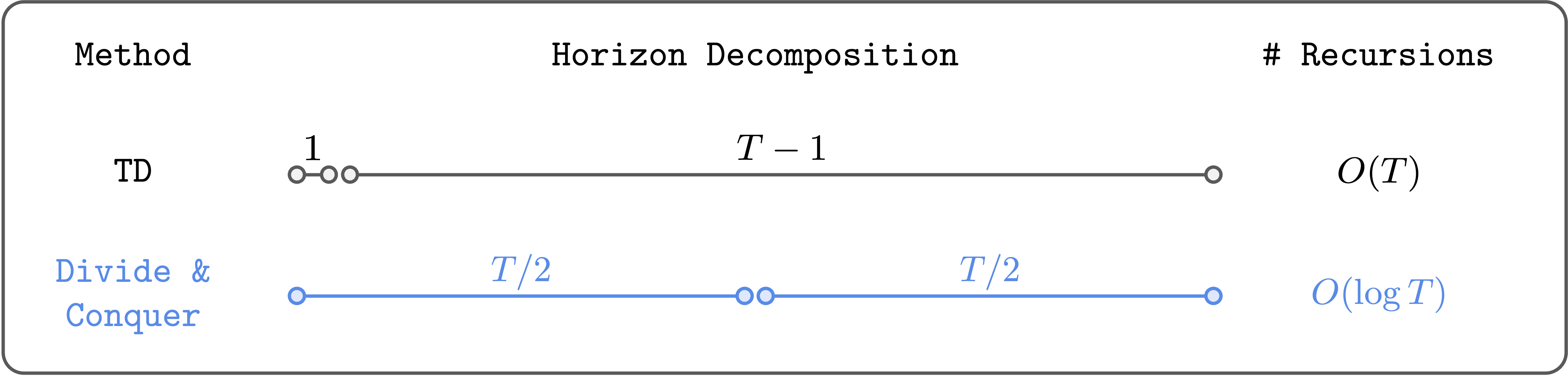
Instead of patching TD, why not avoid it altogether? The divide-and-conquer approach reframes off-policy RL as a series of subproblems. The key insight: break a long-horizon task into shorter segments, solve each segment independently, and combine the solutions. No bootstrapping across distant steps means no error propagation.
How does it work? The algorithm partitions the trajectory into chunks, either randomly or based on state similarities. For each chunk, it learns a local value function using only rewards within that chunk, with a terminal value for the end state (obtained from a separate global value function or by Monte Carlo). The local and global values are then combined through a divide-and-conquer recursion. This recursion ensures consistency without ever using a TD update that spans the full horizon.

In essence, the method replaces the Bellman equation with a compositional structure:
- Divide: Split the problem into subproblems of manageable length.
- Conquer: Solve each subproblem using standard RL techniques (e.g., Q-learning on short horizons, which TD handles well).
- Combine: Merge subproblem solutions via a hierarchical value function that respects the recursion.
This paradigm is particularly appealing for off-policy learning because it can reuse any dataset, as long as the data can be segmented.
Advantages and Potential
The divide-and-conquer method offers several benefits over traditional TD-based off-policy RL:
- Scalability to long horizons: By limiting error propagation to within each chunk, the algorithm avoids the snowball effect. The effective horizon for bootstrapping is reduced to the chunk length.
- Sample efficiency: Because each subproblem is short, the algorithm can learn from fewer interactions, and it can leverage off-policy data more effectively.
- Modularity: Different subproblems can be solved with different algorithms, or even in parallel, enabling easier debugging and optimization.
- Theoretical clarity: The divide-and-conquer recursion provides a clean alternative to the Bellman equation, potentially leading to better convergence guarantees.
Of course, challenges remain—how to optimally partition trajectories, how to handle overlapping or non-Markovian chunks, and how to learn the global combination function efficiently. But early results suggest this paradigm can match or exceed state-of-the-art methods on benchmark tasks with long horizons, such as multi-step navigation and simulated robotics.
Conclusion
Temporal difference learning has been the workhorse of off-policy RL for decades, but its bootstrapping nature imposes a fundamental limitation on horizon length. The divide-and-conquer paradigm offers a principled escape, replacing sequential error propagation with a modular decomposition. While still in its infancy, this approach could unlock off-policy RL for real-world, long-horizon problems where data is precious and every step counts. As research progresses, we may see a shift from patching TD to building new foundations.
Written for the RL community seeking scalable solutions beyond TD.
Related Discussions