HashiCorp Vault Introduces Native AI Agent Security: A Q&A Guide
As organizations increasingly rely on autonomous AI agents to perform complex tasks, traditional identity and access management (IAM) proves insufficient for these non-deterministic actors. HashiCorp Vault's latest announcement introduces native support specifically designed for agentic workflows. This Q&A explores the challenges, new capabilities, and roadmap for securing AI agents with Vault. Jump to sections on authorization model differences, agent registry, or ephemeral authorization for detailed answers.
Why do AI agents require a fundamentally different authorization model compared to traditional users or workloads?
Traditional IAM was built for deterministic users and workflows—humans and scripts with predictable behaviors. AI agents, however, are autonomous and non-deterministic; their actions can vary based on real-time context, learning, and environment. This creates a need for a new authorization model that combines identity, delegation, runtime policy evaluation, and ephemeral permissions. Unlike static access controls that grant standing privileges, agents need temporary, tightly scoped access that aligns with each specific transaction. Without this shift, organizations risk granting excessive permissions that cannot adapt to agent unpredictability, increasing exposure to security breaches. Vault addresses this by introducing primitives that treat agents as distinct entities with their own lifecycle, enabling fine-grained control that matches their dynamic nature.
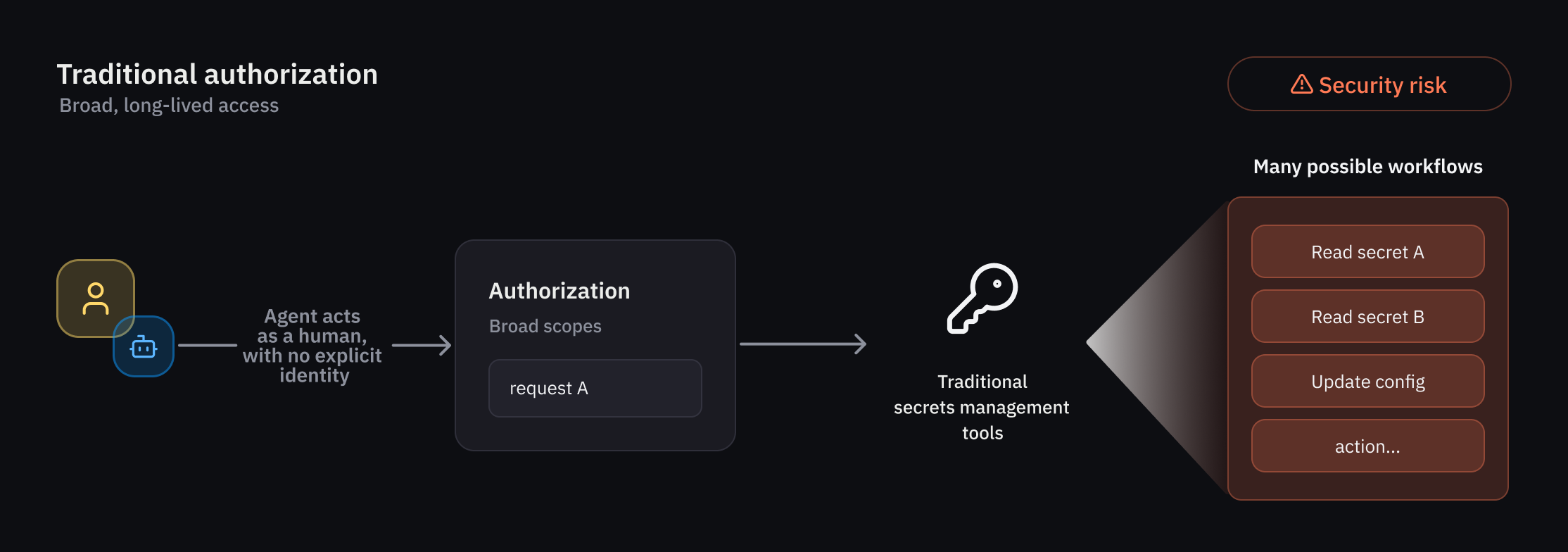
What new security controls does HashiCorp Vault offer for AI agents?
Vault introduces three core capabilities tailored to agentic AI: an agent registry, granular identity-based policies, and per-request (ephemeral) authorization. The agent registry separates agent activity from human and traditional non-human identities (NHIs), providing dedicated oversight. Granular policies enforce runtime guardrails that adapt to non-deterministic behavior, while ephemeral authorization grants temporary access rights that expire after a task or timeframe—reducing the blast radius of compromised agents. Additionally, Vault enhances auditability through clear attribution for actions performed on behalf of users, and standardizes security across different environments. These controls give administrators deterministic guardrails for chaotic agent behaviors, ensuring least privilege without hindering operational efficiency.
How does the agent registry work and what role does it play in delegation flows?
The agent registry is a new identity primitive that allows developers to register and manage AI agents separately from human users or traditional NHIs. This separation is critical in delegation flows, where an agent uses an on-behalf-of (OBO) pattern—carrying the authority of a human user. The registry explicitly tracks this delegation, ensuring that consent and authorization are documented from the start. It forms the foundation for a dedicated framework covering registration, authorization, credential management, and observability. By registering agents independently, administrators gain a clear inventory of all autonomous actors, making it easier to monitor their activities, revoke access when needed, and enforce policies that are specific to agent behavior. This prevents agents from hiding behind human identities and enables precise auditing of delegated actions.
How does Vault enforce granular identity-based policies for non-deterministic agent behavior?
Because agent behavior can be unpredictable, Vault applies deterministic guardrails through a rich set of policy-based runtime controls. These policies evaluate trust across multiple dimensions, especially in delegation mode where an agent carries a human user's authority. Administrators can define rules that limit which secrets an agent may access, under what conditions, and for how long. The policies are scoped to individual actions or workflows, ensuring that even if an agent deviates from expected patterns, it cannot exceed its authorized bounds. This is achieved by tying policies to the agent's identity, the delegating user's identity, and the runtime context of each request. Such granularity ensures least privilege is maintained even when the agent's next move is unknown, significantly reducing the risk of unauthorized access or data exposure.
What is per-request (ephemeral) authorization and how does it reduce risk?
Per-request authorization, also called ephemeral authorization, grants temporary access rights that are valid only for the duration of a specific task or a defined timeframe. For AI agents, this is a paradigm shift from persistent credentials. Instead of holding long-lived secrets that could be stolen or misused, an agent must acquire fresh authorization for each action. This minimizes the blast radius if an agent is compromised—any stolen token is useless after the request window expires. Vault evaluates each request in real-time, combining the agent's identity, the delegating user's context, and policy rules to issue short-lived access. This approach aligns with agentic workflows where actions are transient and context-dependent, providing both security and operational flexibility. Ephemeral authorization is a core component in reducing risk from non-deterministic agents.
How does Vault handle the on-behalf-of (OBO) pattern for agent delegation from human users?
In the on-behalf-of (OBO) pattern, an AI agent acts as an intermediary that carries the authority of a human user. Vault evaluates trust across multiple dimensions: the agent's registered identity, the delegating user's identity, and the specific permissions delegated. The agent registry explicitly tracks this delegation, requiring user consent and ensuring that the agent's actions are attributable to the original requestor. Vault then enforces policies that consider both the agent's capabilities and the delegator's permissions, preventing privilege escalation. This multi-dimensional evaluation allows administrators to define granular delegation rules, such as limiting which tasks the agent can perform or which systems it can access. The result is a secure delegation framework that maintains clear audit trails, showing every action performed on behalf of a user and by which agent—crucial for compliance and forensic analysis.
When will these new capabilities be publicly available? Is there an early access program?
HashiCorp Vault is currently offering these AI agent capabilities through an early access program for select customers. This allows organizations to begin testing the new agent registry, granular policies, and ephemeral authorization controls in their environments while providing feedback to shape the final product. A broader public beta is planned for a future Vault release this summer. Companies interested in evaluating the features early can apply for the early access program. The timeline ensures that the solution is thoroughly vetted for the unique operational and security characteristics of AI agents. Once generally available, these capabilities will be integrated into the standard Vault product, enabling all customers to secure their autonomous systems with the same robust identity and access management that Vault is known for.
Related Discussions